Rack of Ages: What a Los Kumbia Kings T-Shirt Still Says in 2026
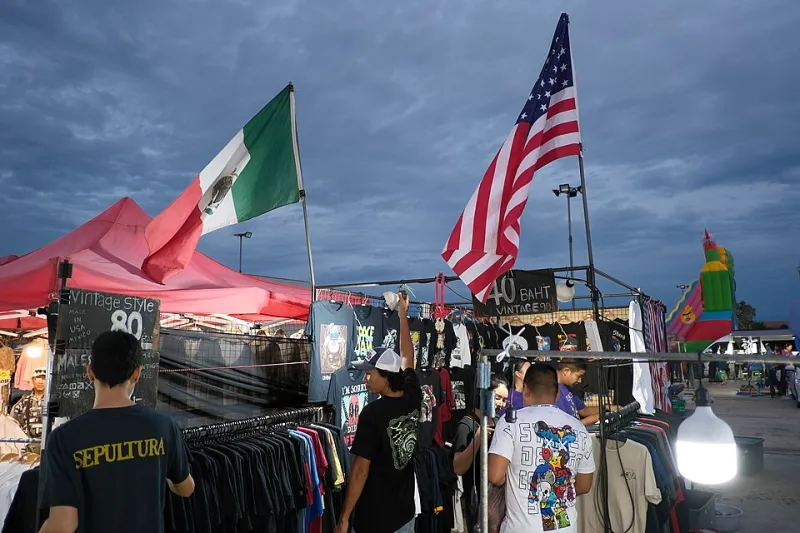
Photo: PattayaPatrol, CC BY-SA 4.0, via Wikimedia Commons
There is a specific kind of hush that falls over a good thrift store rack in San Antonio when a faded black tee with a silver puff-print cursive logo slides into view. The collar is stretched. The hem is curled. Somewhere on the back, half-legible tour dates from two decades ago stack up like a receipt. You do not need the tag to know what it is. You just know.
That shirt — and the thousands like it in closets from Houston to Chicago — is the real Los Kumbia Kings archive. Not the discography, not the press photos. The merch. The stuff that got sweated through at a quinceañera in 2003 and then folded into a drawer, only to resurface at a family barbecue or on a TikTok haul video in 2026.
The Official Rack
Let's start with the legit stuff, because the official merch tells its own story about how the group wanted to be seen. The early-2000s tour tees leaned on the logo: that flowing script, often in silver or white on black, sometimes with a photo of the full lineup printed across the chest like a basketball team. Jerseys were a whole separate genre — mesh, numbered, the kind of thing you wore to a party if you wanted to signal that you were serious about the dance floor and also about looking like you belonged onstage.
"I had the white jersey with the blue lettering," says Marisol R., 38, of Pasadena, Texas. "I wore it to a wedding. My tía told me I looked like I was about to perform. I was not. I was about to eat three plates of birria and dance until the DJ gave up. Same energy, honestly."
The official pieces were never subtle. They were big, shiny, and loud in the way that early-2000s Latin pop merch often was — closer to a sports team than a rock band. That was the point. Los Kumbia Kings were a crowd, not a cult of personality, and the merch let you join the crowd.
Parking Lot Provenance
Then there are the bootlegs, which are, depending on who you ask, either the heart of the archive or the reason to check the stitching before you hand over twenty bucks.
The parking-lot tee was its own economy. Vendors outside venues in the early 2000s figured out fast that fans wanted something to wear home that night, and the official table often ran out or charged more than a teen could afford. So you got the airbrushed version: a photo of the group ironed onto a blank tee, maybe a glitter logo, maybe the wrong year on the back. The colors were sometimes off. The faces were sometimes stretched. Nobody cared.
"I have a bootleg from a show in Houston that spells it 'Kumbia Kingz,'" says Danny V., 41, of Houston. "With a Z. I have worn it to at least four family functions. My cousin tries to buy it off me every Thanksgiving. I tell him it's not for sale. It's not even a good shirt. That's not the point."
That is the point, actually. The bootleg is the memory economy in physical form — a thing that exists because someone wanted to mark an evening, not because a marketing team approved it. In 2026, those pieces turn up on resale apps with prices that range from "sure" to "absolutely not," and the listings almost always include a story: found in my dad's closet, from the 2004 tour, smells like my childhood.
Closet Sociology
Here is where it gets interesting. A Los Kumbia Kings shirt in 2026 is not just nostalgia. It is a signal, and the signal is layered.
For older fans, it says: I was there. I remember the lineup changes, the radio singles, the era when cumbia was the default sound at every family party in a certain kind of American city. For younger fans — the ones who found the group through their parents, or through a playlist, or through a TikTok clip of a live show — the shirt says something different: I know where this comes from, and I claim it.
"I bought a vintage tee on Depop for way too much money," says Camila T., 24, of Chicago. "My mom laughed at me. Then she asked if I could find her one in a medium. Now we both have one. We wore them to a cookout and my uncle almost cried. It was a whole thing."
The visual details matter here. The faded black, the cracked lettering, the way the shirt hangs a little boxy because it was cut for a different decade — these are not flaws. They are proof of time. A crisp new reproduction would not do the same work. The wear is the credential.
The TikTok Tailgate
And then there is the newest layer: the homemade stuff. In 2026, you can find fans cutting vinyl letters with a Cricut, printing iron-on transfers, and stitching patches onto denim jackets. The results are sometimes rough and always personal. A shirt that says My Mom Raised Me on Kumbia in a chunky font. A tote bag with the logo and a lyric. A baby onesie with a tiny jersey number.
This is the memory economy in its most active form — not buying the past but remaking it by hand. It is also, frankly, the most on-brand thing imaginable for a fan base that has always treated the group's music as a family inheritance rather than a product.
What We Keep
The merch table time machine does not take you back to a specific night. It takes you back to a feeling: the sweat, the bass, the cousin who always requests the same song. A shirt is just a shirt until someone wears it to a funeral, a wedding, a first day of school, a random Tuesday.
So if you are cleaning out a closet this year and you find a cracked-print tee with a stretched collar and a logo you have not thought about in years, do not toss it. Someone in your family — or someone on the internet — will want it. The archive is not in a museum. It is on a hanger, in a plastic bin, waiting for the next party.