Push the Chairs Back: Los Kumbia Kings and the School-Gym Cumbia Test
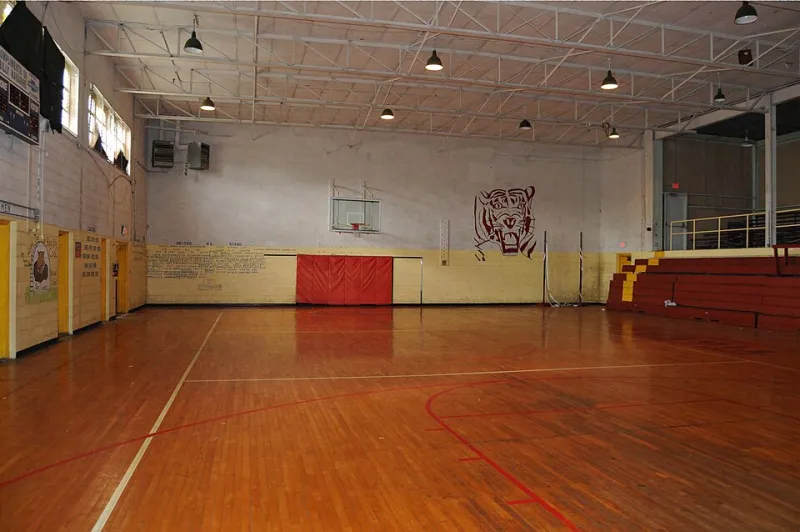
Photo: Jessica Richardson, Public domain, via Wikimedia Commons
The folding chair is not a dance partner. But at a US school gym in the 2000s, it was the first thing you moved. Before the first chorus, before the DJ found the right volume, before anyone worked up the nerve to ask somebody to dance, there was the scrape of metal legs on waxed wood. Chairs went back. Tables went sideways. The bleachers stayed folded. And for a few hours, a room built for pep rallies and standardized testing became something closer to a cumbia floor.
That is the part of the Los Kumbia Kings story that does not always make the liner notes: the school-gym chapter. Not the amphitheater. Not the quinceañera hall. The gym. The place with the echo, the crepe paper, the smell of floor wax and borrowed cologne, and a sound system that could turn a bassline into a rumble if you stood too close to the speaker stack.
The Gym Was a Hostile Room for Almost Everything Else
A school gym is not designed for intimacy. It is designed for durability. The walls are hard, the ceiling is high, and every sound bounces back a half-second late. A ballad can die in there. A complicated dance track can turn into mush. But cumbia has always been good at surviving bad rooms. The beat is steady, the bass is simple enough to cut through concrete, and the chorus is usually a group activity.
Los Kumbia Kings understood that. Their catalog from the 2000s was full of songs that did not need a perfect club system to work. Tracks like Shhh! and No Tengo Dinero had hooks that could travel across a crowded gym. Te Quiero a Ti gave the couples something to lean into. Dulce Niña had enough bounce to pull the wallflowers out by the second verse. The highs might get swallowed by the gym, but the low end and the melody kept moving.
That is why the chairs went back. The music did not ask for a formal dance floor. It asked for space. And in a school gym, space was something you could make with your hands.
Between the Pep Rally and the Parking Lot
For second-generation Latino kids in the 2000s, school dances were a strange social experiment. You were in an American school, with American rituals, but the music could suddenly sound like home. Or like your cousin's wedding. Or like the tape your older brother played in the truck. Los Kumbia Kings sat right in that overlap. They mixed cumbia with Tejano, pop, hip-hop, and R&B. They sang in Spanish and English. They did not force you to choose a side.
That mattered in the cafeteria, too. Lunchtime debates about which album was better, which song was the real banger, whether the remix counted, whether the slow song was actually danceable. Kids who did not speak Spanish sang the choruses phonetically. Kids who did speak Spanish translated for friends. Nobody had to explain why the beat worked. The beat just worked.
In a gym, that kind of music becomes a neutral zone. It did not matter if you were a top-student type, a quiet kid, a troublemaker, or the person who only came because their friend drove. When the right Los Kumbia Kings song came on, the floor filled up. Not perfectly. Not professionally. But together.
Choreography by Furniture
There is a reason the school-gym experience feels so specific. The choreography was partly architectural. You pushed chairs. You stacked them. You made a runway between the bleachers and the exit. You used the edge of the floor as a boundary until someone got brave and moved the boundary back. The gym became a cumbia room by force of will and cheap metal furniture.
The dancing matched the room. Side-steps. Group circles. Couples who knew the song and couples who were pretending. Guys nodding at the edge of the circle. Girls running a line dance that was half-invented and half-remembered. Sneakers squeaking on the wax. Someone's mom waiting in the parking lot with the headlights on. The last slow song. The lights coming up. The smell of floor wax and borrowed cologne still hanging in the air.
Hearing those songs in 2026 can bring all of that back faster than a photo. Not because the gym was glamorous. Because it was real. The school dance was a low-stakes testing ground. If a Los Kumbia Kings song could move a room with bad acoustics and a nervous crowd, it could move a wedding, a quinceañera, a parking-lot pregame, or a taco-truck line later that night.
What the Gym Test Proved
The school-gym chapter is not the biggest part of the Los Kumbia Kings legacy, but it might be the most revealing. It showed that their music was portable. It did not need velvet ropes or a perfect mix. It needed people who were willing to push the chairs back and give the chorus somewhere to land.
In 2026, that memory lives in group chats, wedding playlists, and short clips of people dancing in kitchens and driveways. But the original version was a gym. Fluorescent lights. Crepe paper. A DJ hoping the CD would not skip. And a room full of kids learning that a cumbia groove could make even the most institutional space feel like it belonged to them.