Boombox Proof: Why Los Kumbia Kings Sound Massive on Cheap Speakers
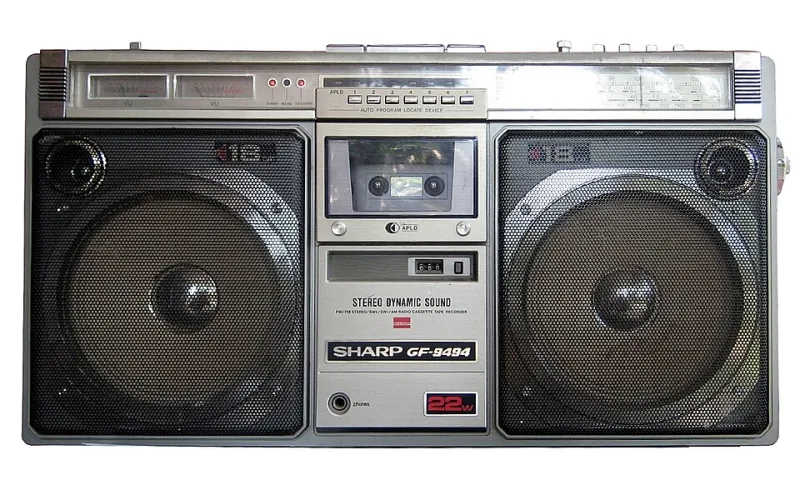
Photo: Stephen Michael Barnett from Adelaide, Australia, CC BY 2.0, via Wikimedia Commons
There’s a specific kind of listening test that never shows up in audiophile reviews. It happens in a used Civic with one working door speaker. It happens on a plastic boombox balanced on a folding table at a swap meet. It happens when somebody’s cousin connects a phone to a Bluetooth speaker that cost less than the tacos. And somehow, Los Kumbia Kings keep passing it.
That’s not an accident. The group’s best-known records were built for motion, not for quiet headphones. They were made to be heard over traffic, over conversation, over the clatter of a family party. The mixes are busy, but they’re busy in a smart way: the parts that matter are loud, repetitive, and parked right where a cheap speaker can find them. In 2026, when the catalog is just as likely to come through a phone speaker as a car stereo, that design still pays off.
The $20 Boombox Is a Real A/B Test
A cheap speaker is basically a stress test. It flattens high-end sparkle. It turns deep bass into a fuzzy rumble. It compresses everything into a narrow band of sound. If a song depends on subtle vocal texture or a delicate hi-hat pattern, that detail disappears. If a song depends on a chant, a keyboard hook, and a bassline that repeats every few seconds, it survives.
Los Kumbia Kings records tend to load up on the second category. The cumbia bass often sits in a range that cheap speakers can actually reproduce, even if it comes out slightly distorted. The keyboard lines are bright and simple enough to cut through road noise. The choruses arrive early and repeat often. And the backing vocals are stacked wide, which gives the mix a “big room” feel even when the room is a parking lot.
What Survives a Blown Cone
A fan doesn’t need a production degree to notice this. They just need a memory of a car ride where the bass was rattling the door panel and everybody still knew every word. The songs that work in that setting share a few traits.
First, the low end is melodic, not just heavy. A cumbia bassline that moves in a catchy pattern gives the ear something to follow, even when the speaker can’t reproduce the full tone. Second, the keyboards often function like a second vocal: short, sharp phrases that punch through the midrange. Third, the choruses are usually group efforts. When five or six voices hit the same phrase, the song sounds fuller on a tiny speaker because the vocal energy is spread across the frequency range.
That combination is why a track like “No Tengo Dinero” still reads on a bad speaker. The hook is plain, the rhythm is steady, and the vocal chant is almost impossible to bury. It doesn’t need clarity. It needs volume and repetition, and cheap speakers are great at volume.
Bass That Reads Through Plastic
There’s a difference between bass you feel and bass you hear. On a good system, you get both. On a $20 boombox, you mostly get the hear part. Los Kumbia Kings mixes tend to make peace with that reality. The basslines are often written to be recognized even when the low end is thin. They thump, but they also walk. They outline a melody. That melodic movement is the secret handshake that lets a cheap speaker communicate the groove.
The same goes for the kick and percussion. The cumbia rhythm is sturdy enough to survive compression. It doesn’t rely on a single fragile sound. It’s a cluster of hits and shuffles that keep the pulse alive even when the speaker starts to sound like it’s chewing aluminum foil.
Choruses Before the Static
A lot of modern pop waits until the listener is invested before it delivers the hook. Los Kumbia Kings often take the opposite approach: the hook arrives early and keeps coming back. That’s an advantage on low-fidelity playback. If the chorus is already in the first thirty seconds, the song has something to say before the speaker has a chance to fall apart.
“Shhh!” is a good example. The whispered hook, the keyboard figure, and the bass pattern all lock together quickly. You don’t need a pristine mix to understand what the song is doing. The shape is clear. The same is true for “Fuego,” where the vocal chant and the rhythmic push do most of the heavy lifting. The song doesn’t ask the speaker to be fancy. It asks the speaker to be loud.
Gang Vocals as Cheap-Speaker Insurance
One of the most underrated tools in the group’s catalog is the gang vocal. When multiple voices sing the same line, the sound gets thicker and more durable. A single voice can get lost in a distorted car speaker. A group of voices tends to smear into a single bright block that cuts through. That’s not a small detail. It’s a practical design choice that makes the music feel like a crowd, even when the crowd is just one person driving to work.
That “crowd” feeling is a big part of the fan culture around Los Kumbia Kings. These are songs that invite people to sing along, and the recordings often sound like a party already in progress. On a bad speaker, that party energy survives better than polish would.
The Bad-Speaker Durability Ranking
This is not a ranking of the best songs. It’s a ranking of how well each track holds up when the playback system is held together by hope. Call it the blown-cone index.
S-tier: “No Tengo Dinero.” The bass hook, the chant, the simple chorus. This is the gold standard for cheap-speaker survival. It could probably play through a paper cup and still make sense.
S-tier: “Shhh!” The whisper cuts through, the keyboard line is catchy, and the groove is sturdy. It sounds good loud and slightly broken.
A-tier: “Fuego.” The vocal energy and percussion keep the song moving even when the low end gets fuzzy. A reliable parking-lot track.
A-tier: “Azul.” The melody is strong enough to survive a thin speaker, though it benefits from a little more clarity than the S-tier picks.
B-tier: “Dime Quién.” A great song, but one that asks a bit more from the playback system. On a truly terrible speaker, some of the vocal nuance gets lost.
B-tier: “Te Quiero a Ti.” The chorus lands, but the mix rewards a system that can separate the parts. In a noisy car, it can start to blur.
Why This Still Matters in 2026
The way people listen has changed, but the principle hasn’t. Phone speakers are small. Car speakers are often old. Parties move outdoors. The music that travels best is the music that gives the listener a clear handle: a bassline, a chant, a chorus, a rhythm. Los Kumbia Kings built a catalog full of those handles.
That’s why the group still works at a backyard cookout, a quinceañera, a tailgate, or a swap-meet parking lot. The songs don’t need perfect conditions. They need a little volume and somebody willing to move. A $20 boombox is not the ideal way to hear Los Kumbia Kings. But it might be one of the most honest ways to understand why the music endures.